
Psychiatric access gaps often become visible after the first behavioral health concern has already been identified. A clinic may recognize that a patient needs psychiatric support, begin the referral process, and still face limited capacity for psychiatric evaluation, medication management, follow-up care, and care-team communication.
That challenge is becoming harder for many healthcare organizations to plan around. The American Psychiatric Association cites workforce projections estimating that demand for adult psychiatric services will increase by 3% by 2030, while the adult psychiatrist supply is projected to decrease by 20%. For FQHCs, community health centers, rural clinics, county clinics, safety-net organizations, and Tribal health programs, the psychiatrist shortage is not only a recruiting problem. It is a capacity-planning issue that affects how behavioral health services function day to day.
Where Psychiatric Capacity Problems Show Up
For healthcare leaders, psychiatrist shortages rarely appear as one isolated problem. They often show up across several points in the care pathway.
A patient may need a psychiatric evaluation before a treatment plan can move forward. Another may need medication management follow-up after a dosage change. A primary care provider may need specialty input while managing behavioral health complexity in the absence of timely psychiatric support.
When psychiatric coverage is limited, these needs can create pressure across the clinic. Referral pathways slow down. Follow-up planning becomes harder to maintain. Primary care and behavioral health teams may carry more responsibility while waiting for specialty support.
The result is a gap between what clinics want to provide and what current provider capacity allows.
Core Barriers for Clinic Leaders
Many healthcare organizations are already working to expand behavioral health access. The harder question is whether psychiatric provider coverage, medication-management capacity, and clinic workflows can keep pace with that demand.
Common barriers include:
- Limited psychiatric specialist availability
- Rising behavioral health referrals
- Delayed referral completion and follow-up planning
- Primary care teams managing psychiatric needs without enough specialty support
- Documentation, scheduling, and coordination strain on existing staff
These barriers affect more than appointment availability. They influence patient access, care-team workload, quality processes, and the long-term stability of behavioral health programs.
For clinics serving rural or underserved communities, the challenge can be especially difficult when local psychiatrist recruitment alone cannot reliably meet patient needs.
How Clinic-Based Telepsychiatry Supports Access
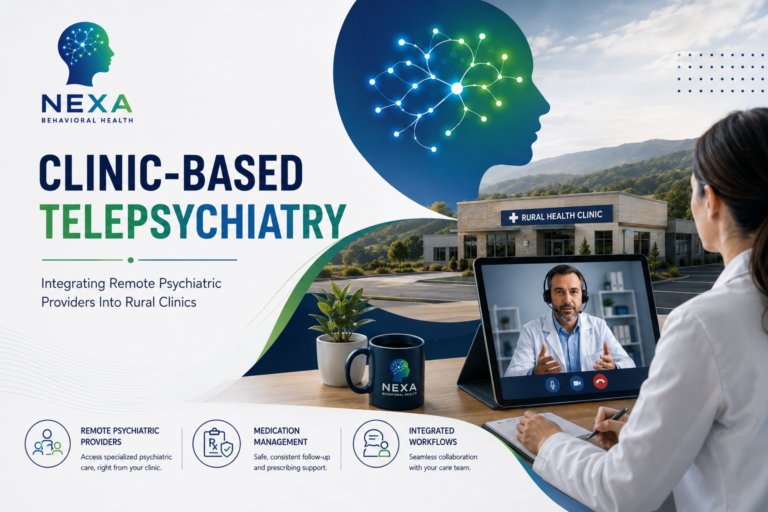
Clinic-based telepsychiatry is not simply a remote version of filling open provider slots. When implemented carefully, it can help clinics bring psychiatric expertise into the care setting patients already use while supporting existing clinical workflows.
A coordinated telepsychiatry model may support:
- Psychiatric evaluations
- Psychiatric medication management
- Follow-up psychiatric care
- Clinical collaboration with primary care and behavioral health teams
- Care coordination across clinic sites or service lines
For Nexa Behavioral Health, the emphasis is on helping clinics strengthen psychiatric access through remote psychiatrists and psychiatric nurse practitioners. This model can support medication management, follow-up care, and clinical collaboration through secure telehealth.
Nexa’s clinic-based approach is designed for organizations such as FQHCs, Rural Health Clinics, Community Health Centers, Critical Access Hospitals, County Health Clinics, Tribal Health Clinics, and other community-based providers.
What Leaders Should Plan Before Implementation
Expanding psychiatric access requires more than adding providers to a schedule. Clinics need workflows that make telepsychiatry usable for patients, providers, and care teams.
Key operational areas include:
- Referral management workflows
- Provider communication protocols
- Documentation and quality reporting standards
- Reimbursement and billing processes
- Patient engagement systems
- Compliance and technology readiness
For Federally Qualified Health Centers, leaders may also account for Medicaid protocols, Prospective Payment System requirements, UDS reporting, and integration with primary care teams. Strong implementation planning helps clinic-based telepsychiatry support continuity, access, and operational sustainability.
Building a More Sustainable Psychiatric Access Model
The psychiatrist shortage is unlikely to be solved by local hiring alone. Clinics need practical models that help them connect psychiatric expertise with existing behavioral health, primary care, and care coordination infrastructure.
Clinic-based telepsychiatry can be part of that strategy. It gives healthcare organizations a way to extend psychiatric provider access while keeping care connected to the clinic’s own workflows and patient relationships.
For clinics facing behavioral health staffing challenges, referral delays, or limited local specialty support, the goal is not simply to add more appointments. The goal is to create a psychiatric access model that supports evaluation, medication management, follow-up, documentation, and communication over time.
Future Outlook
Behavioral health demand, psychiatric workforce shortages, and sustainability pressures will continue shaping how clinics plan access. Organizations that rely only on local hiring may continue to face persistent gaps, especially in rural and underserved markets.
The next phase of behavioral health strategy will likely depend on coordinated models that connect psychiatric providers, clinic teams, workflows, technology, and clear access priorities.
Looking to Expand Psychiatric Medication Management?
Learn how Nexa Behavioral Health partners with clinics to expand psychiatric medication management capacity, support care coordination, and strengthen clinic-based behavioral health programs through secure telepsychiatry.
Schedule a Nexa Site Assessment →
Sources
American Psychiatric Association. “Workforce Development.” Accessed July 2026.
https://www.psychiatry.org/psychiatrists/advocacy/federal-affairs/workforce-development
Health Resources and Services Administration. Behavioral Health Workforce Projections, 2017–2030.
https://bhw.hrsa.gov/sites/default/files/bureau-health-workforce/data-research/bh-workforce-projections-fact-sheet.pdf
Health Resources and Services Administration. State of the Behavioral Health Workforce, 2025. 2025.
https://bhw.hrsa.gov/sites/default/files/bureau-health-workforce/data-research/Behavioral-Health-Workforce-Brief-2025.pdf
Health Resources and Services Administration. “Health Workforce Projections.” Accessed July 2026.
https://data.hrsa.gov/topics/health-workforce/workforce-projections
Frequently Asked Questions
What is psychiatric access planning?
Psychiatric access planning is the process of determining how patients will receive psychiatric evaluation, medication management, follow-up care, and specialist collaboration. It includes provider capacity as well as referral, scheduling, documentation, communication, technology, and reimbursement workflows.
How can clinic-based telepsychiatry support psychiatric access?
Clinic-based telepsychiatry can connect remote psychiatric providers with patients and care teams through the clinic’s established setting. Depending on the program, it may support evaluations, medication management, follow-up care, and collaboration with primary care and behavioral health teams.
Does clinic-based telepsychiatry replace local clinic teams?
No. Clinic-based telepsychiatry generally functions as an extension of the clinic’s existing care model. Responsibilities, communication procedures, and follow-up workflows should be defined before services begin.
What should leaders evaluate before implementing telepsychiatry?
Leaders should evaluate patient demand, provider responsibilities, referral workflows, documentation, communication, reimbursement, credentialing, technology, privacy, patient engagement, and quality-reporting requirements.