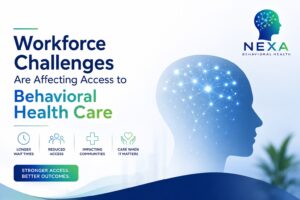
Many healthcare organizations are seeing the effects of behavioral health workforce shortages firsthand.
Finding qualified providers continues to be a challenge, and for some organizations, open positions can remain vacant for months. At the same time, demand for behavioral health services continues to grow.
According to the HRSA National Center for Health Workforce Analysis, approximately 137 million Americans, or roughly 40% of the population, live in designated Mental Health Professional Shortage Areas. As a result, many patients face longer wait times and fewer options when seeking care.
What starts as a workforce challenge can quickly become an access challenge.
The Growing Demand for Care
Over the last several years, more people have sought behavioral health services. Increased awareness of mental health, expanded telehealth options, and growing community needs have all contributed to higher demand.
While demand continues to increase, provider availability has not kept pace. This leaves many organizations working to balance growing patient needs with limited clinical resources.
For patients, that can mean waiting weeks or even months for an appointment.
The Impact on Patients and Communities
Provider shortages affect more than schedules.
When organizations do not have enough behavioral health professionals available, the effects are often felt throughout the patient experience.
Common challenges include:
- Longer wait times for appointments
- Reduced access to ongoing treatment
- Delays in follow-up care
- Increased pressure on existing providers
- Limited ability to expand services within communities
Many organizations are doing everything they can to meet demand, but workforce shortages continue to make that difficult.
Strategies Organizations Are Using Today
Healthcare organizations are exploring a variety of ways to maintain access to care despite workforce challenges.
Some are expanding telepsychiatry services to reach more patients. Others are incorporating psychiatric nurse practitioners and team-based care models to better support existing providers. Many organizations are also developing coverage plans that help reduce disruptions when staffing changes occur.
While there is no single solution, these efforts can help organizations continue providing care while adapting to a changing workforce landscape.
How Nexa Behavioral Health Helps
Nexa Behavioral Health works with healthcare organizations that are looking for ways to maintain access to behavioral health services and support continuity of care.
Whether an organization is experiencing provider shortages, planning for growth, or looking to expand access in underserved communities, flexible psychiatric and telebehavioral health support can help address gaps while maintaining consistent patient care.
The goal is simple: helping organizations connect patients with care when they need it.
Looking Ahead
Behavioral health workforce shortages remain a challenge across the country, and many organizations are continuing to look for practical ways to support patients while managing limited provider resources.
Organizations that plan ahead, evaluate coverage needs, and explore flexible care models are often better positioned to maintain access and continuity of care.
If you would like to discuss options for expanding access to behavioral health services and supporting continuity of care within your organization, we invite you to connect with Nexa Behavioral Health.
Resources:
American Psychiatric Nurses Association. (2025). The state of the psychiatric-mental health nursing workforce. https://www.apna.org/wp-content/uploads/2025/10/APNA_2025_State_of_Psychiatric-Mental_Health_Nursing_FINAL.pdf
Becker’s Behavioral Health. (2026, January 14). Mental healthcare provider gaps by state. https://www.beckersbehavioralhealth.com/behavioral-health-mental-health/mental-healthcare-provider-gaps-by-state/
California Health Care Access and Information. (2025). Supply and demand modeling for California’s behavioral health workforce. https://hcai.ca.gov/visualizations/supply-and-demand-modeling-for-californias-behavioral-health-workforce/
Health Resources and Services Administration. (2025). State of the behavioral health workforce. U.S. Department of Health and Human Services. https://bhw.hrsa.gov/sites/default/files/bureau-health-workforce/data-research/Behavioral-Health-Workforce-Brief-2025.pdf
National Institute for Health Care Management Foundation. (2025). Health care workforce shortages. https://nihcm.org/newsletter/rising-healthcare-workforce-shortage