
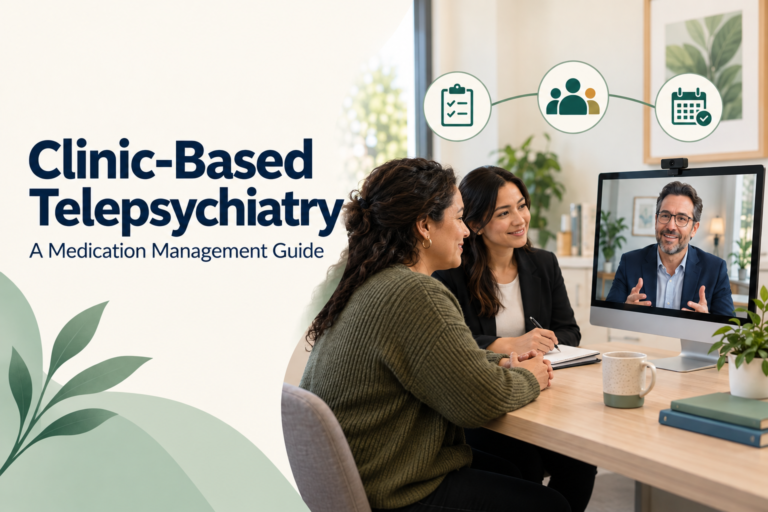
Psychiatric access problems often become visible at the medication-management stage. A clinic may identify a behavioral health need yet still lack timely capacity for psychiatric evaluation, prescribing support, and structured follow-up. That gap can leave primary care and behavioral health teams managing complex handoffs without enough specialty support.
The scale of unmet need reinforces the operational challenge. The Substance Abuse and Mental Health Services Administration (2025) reported that only 12.1% of adults with a substance use disorder in 2024 received treatment that year. For clinics, clinic-based telepsychiatry can be one component of a more dependable psychiatric access plan.
Where the Bottleneck Appears
Medication management is a continuing clinical process rather than a single prescribing encounter. Clinics need a reliable way to smoothly transfer patients from referral to psychiatric evaluation, monitoring, and medication management follow-up.
Referral delays can increase when local psychiatric coverage is limited, or roles are unclear. They may also emerge when scheduling, records, laboratory information, patient communication, and follow-up responsibilities sit in separate workflows. The problem is therefore not only provider availability; it is whether the clinic has designed an efficient path around that provider.
What Remote Psychiatric Providers Add
Remote psychiatric providers can extend specialty capacity into the clinic without requiring every service to be built solely on local recruitment. Psychiatrists and psychiatric nurse practitioners can participate in clinic-based care while local professionals retain their roles in primary care, counseling, case management, and community support.
A coordinated model may support:
- Psychiatric evaluations and treatment planning
- Psychiatric medication management and appropriate monitoring
- Scheduled consultation with local clinical teams
- Defined communication after medication changes
- Escalation to urgent or in-person services when needed
In a CDC-led study (2022) of 175,778 Medicare beneficiaries, receipt of opioid-use-disorder telehealth services was associated with better retention in medications for opioid use disorder and a lower risk of medically treated overdose. The finding does not mean every patient or service belongs online. It does show why leaders should evaluate telehealth as part of a carefully governed continuity strategy.
Designing the Clinic Workflow
Successful integration depends on decisions made before the first remote visit. Leaders should map how patients, information, and responsibilities move through the program.
Key questions include:
- Who confirms referral readiness and schedules the appointment?
- What information must reach the psychiatric provider beforehand?
- Who communicates the plan to the patient and care team?
- How are monitoring, refills, and missed visits handled?
- What triggers an urgent evaluation or in-person referral?
The California Telehealth Resource Center (2026) notes that digital services work best when paired with clear clinical workflows, patient outreach, privacy protections, and compliance oversight. Aligning telehealth with existing behavioral health workflows can support care coordination while avoiding a separate, disconnected service track.
Measuring a Durable Access Model
Clinic leaders need measures that show whether psychiatric provider coverage functions reliably across daily operations. Useful operational indicators may include time from referral to appointment, referral completion, follow-up completion, documentation turnaround, and unresolved handoffs.
Leaders should review these measures alongside clinical quality, patient experience, equity, and staff workload. They should also validate licensing, prescribing, privacy, reimbursement, and emergency-response requirements for the relevant services and jurisdictions. This approach is especially important for community health centers and other clinics coordinating multiple sources of behavioral health support.
Future Outlook
Sustainable psychiatric access will depend greatly on how well clinics integrate available professionals, not simply where those professionals are located. Clinic-based telehealth models can help leaders plan coverage across sites while preserving local relationships and in-person options. The next step is building remote psychiatric provider integration around dependable communication, follow-up, and accountability.
Looking to Strengthen Psychiatric Medication Management?
Learn how Nexa Behavioral Health partners with clinics to expand psychiatric medication-management capacity, support care coordination, and strengthen clinic-based behavioral health programs through secure telepsychiatry.
Schedule a Nexa Site Assessment →
References:
Substance Abuse and Mental Health Services Administration. (2025, September). Substance use treatment among people who had a substance use disorder in the past year. https://www.samhsa.gov/data/sites/default/files/reports/rpt56617/2024-nsduh-psr4-sutx-among-sud.pdf
Centers for Disease Control and Prevention. (2022, August 31). Increased use of telehealth for opioid use disorder services during COVID-19 pandemic associated with reduced risk of overdose. https://archive.cdc.gov/www_cdc_gov/media/releases/2022/p0831-ccovid-19-opioids.html
Trujillo, S., & Ochoa-Ruiz, E. (2026, June 8). Digital health as a recovery tool: Telehealth, mobile supports, and remote engagement in the opioid and substance use crisis. California Telehealth Resource Center. https://caltrc.org/uncategorized/digital-health-as-a-recovery-tool-telehealth-mobile-supports-and-remote-engagement-in-the-opioid-and-substance-use-crisis/
Frequently Asked Questions
How should clinics divide responsibilities with remote psychiatric providers?
Clinics should define who manages referrals, scheduling, clinical information, patient communication, monitoring, and escalation. Responsibilities should be documented before services begin.
What should happen before the first remote psychiatric visit?
The clinic should confirm referral readiness, provide relevant records, identify the local point of contact, and establish follow-up and emergency procedures.
How can leaders assess whether the model fits their clinic?
Leaders should evaluate patient needs, current workflow gaps, provider roles, technology readiness, regulatory requirements, and the clinic’s ability to coordinate follow-up.