

Healthcare organizations often recognize provider burnout through its visible effects: declining morale, increased turnover, difficulty maintaining schedules, and growing pressure on clinical teams. However, addressing these challenges requires looking beyond the symptoms and examining how care is organized and delivered.
In behavioral health, providers must balance clinical decision-making, patient engagement, treatment planning, documentation, and coordination across care settings. These responsibilities are essential to quality care, but when the systems supporting them are not designed to accommodate these demands, even experienced clinicians can find it difficult to maintain a sustainable workload.
Although individual wellness initiatives have an important place in healthcare, they cannot independently resolve organizational challenges that contribute to provider exhaustion. Long-term improvements require healthcare leaders to consider how clinical services are structured and whether existing care models adequately support the professionals delivering them.
When the Structure of Care Becomes Part of the Problem
Provider burnout is frequently discussed in terms of stress management, resilience, and work-life balance. While these considerations matter, they represent only part of a much broader conversation.
The National Academies of Sciences, Engineering, and Medicine (NASEM, 2019) emphasizes that clinician burnout must be addressed through changes to the healthcare systems and work environments in which providers practice.
This distinction is especially important in behavioral healthcare. Clinical teams often work within interconnected service models where psychiatric evaluations, medication management, behavioral health interventions, and ongoing patient monitoring must function together.
When these services are difficult to coordinate, providers may spend additional time navigating operational barriers rather than concentrating on clinical responsibilities. Gaps in psychiatric availability, fragmented communication, and inefficient care processes can make an already demanding clinical environment more difficult to manage.
The challenge, therefore, is not simply how providers cope with their workloads, but whether organizations are creating conditions that allow those workloads to remain manageable.
Rethinking How Psychiatric Services Are Delivered

One consideration for healthcare organizations is whether their existing psychiatric care model can adequately accommodate patient needs without placing disproportionate demands on their clinical teams.
Limited psychiatric availability can create bottlenecks throughout the care process. Delays in evaluations, medication management, and follow-up services may affect scheduling, coordination, and the ability of other providers to address patient needs.
Expanding psychiatric service capacity can help organizations address some of these limitations. Telepsychiatry, in particular, offers an opportunity to incorporate psychiatric expertise into existing care environments through a virtual service model.
Rather than operating as a separate or disconnected service, telepsychiatry can complement existing clinical operations when supported by clear communication, established workflows, and coordination among providers.
For healthcare organizations, this approach can offer several operational advantages:
- Greater access to psychiatric expertise: Virtual psychiatric services can help extend access to psychiatrists and psychiatric nurse practitioners, particularly in communities where local availability is limited.
- Additional clinical capacity: Integrating external psychiatric services into an existing care model can help organizations accommodate patient needs without relying exclusively on their internal clinical resources.
- Continuity across treatment needs: Access to psychiatric evaluations, medication management, and follow-up services supports a more coordinated approach to ongoing patient care.
- Stronger clinical collaboration: Establishing clear coordination between psychiatric providers and existing care teams helps connect psychiatric services with the broader treatment environment.
These considerations are not a substitute for addressing workload expectations or workplace conditions. However, they demonstrate how thoughtful service design can contribute to a more sustainable approach to psychiatric care.
Moving Beyond Individual Wellness Initiatives
Healthcare organizations have increasingly recognized the importance of provider wellness. Employee assistance resources, professional development, peer support, and opportunities for work-life balance can all contribute to a healthier workplace.
However, these initiatives are most meaningful when supported by organizational practices that reinforce their purpose.
For example, encouraging providers to prioritize their well-being becomes difficult when clinical schedules leave little room for administrative responsibilities, care coordination, or professional development.
Similarly, promoting collaboration requires more than encouraging communication. Organizations must establish workflows that allow providers to work together effectively without introducing unnecessary administrative burdens.
The Substance Abuse and Mental Health Services Administration (SAMHSA, 2022) highlights the importance of organizational conditions in addressing burnout among behavioral health professionals.
For healthcare leadership, this reinforces an important consideration: provider well-being should be reflected in the way clinical operations are designed, not treated as a separate initiative.
A sustainable clinical environment requires alignment between organizational expectations, available resources, and the actual demands placed on providers.
Building a More Sustainable Approach to Psychiatric Care
There is no single strategy that can eliminate provider burnout. However, healthcare organizations can make meaningful progress by evaluating whether their existing service models support both clinical effectiveness and provider well-being.
This may involve reconsidering how psychiatric services are accessed, identifying opportunities to improve coordination, and evaluating whether current resources are sufficient to meet patient demand.
For organizations with limited access to psychiatric professionals, establishing a telepsychiatry partnership may be one way to strengthen existing services while supporting broader organizational goals.
The objective is not simply to increase service availability. It is to create a care delivery structure in which psychiatric expertise, clinical coordination, and organizational resources work together to support consistent patient care.
Ultimately, the sustainability of healthcare services depends on recognizing that the people delivering care are directly affected by the systems in which they work.
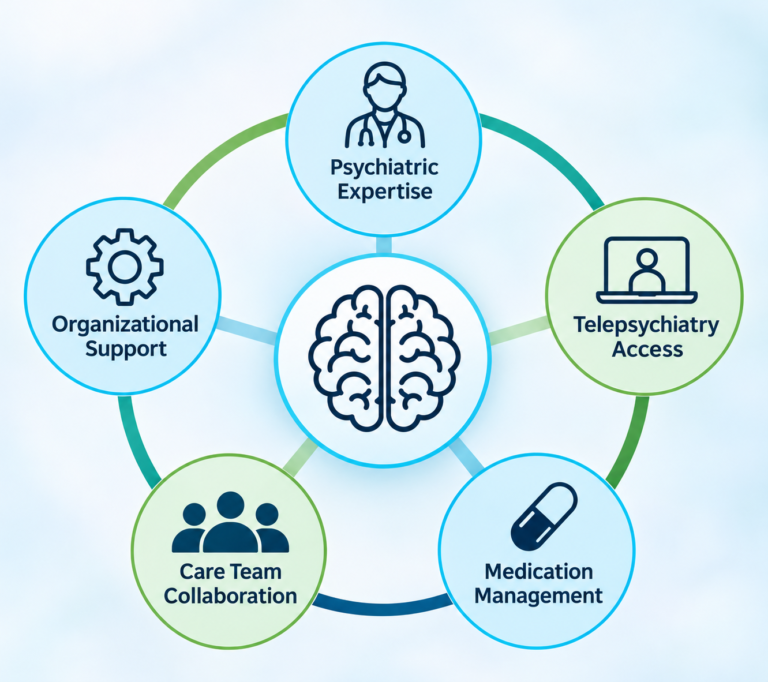
How Nexa Supports a More Connected Model of Psychiatric Care

At Nexa, we believe accessible psychiatric care and effective clinical collaboration are important components of a well-supported healthcare environment.
We partner with healthcare organizations to integrate telepsychiatry and medication management services into existing care models, providing access to psychiatrists and board-certified psychiatric nurse practitioners through a remote care approach.
Our partnership extends beyond provider access. Nexa supports organizations with clinical oversight, telehealth training, credentialing assistance, equipment support, and ongoing coordination to help establish and maintain their psychiatric programs.
By working alongside existing clinical teams, we help organizations strengthen psychiatric service availability while supporting the operational needs of their care environments.
A stronger approach to psychiatric care begins with a model that supports both the providers and the patients who depend on them.
Strengthening Psychiatric Care Starts with the Right Partnership
Is your organization evaluating ways to expand psychiatric services, improve care coordination, or strengthen its existing telepsychiatry program?
Connect with Nexa to explore how our telepsychiatry and medication management services can complement your clinical operations and support your organization’s long-term care delivery goals.
References
National Academies of Sciences, Engineering, and Medicine. (2019). Taking action against clinician burnout: A systems approach to professional well-being. The National Academies
Press. https://doi.org/10.17226/25521
Substance Abuse and Mental Health Services Administration. (2022). Addressing burnout in the behavioral health workforce through organizational strategies (Publication No. PEP22-06-02-005).
U.S. Department of Health and Human Services.https://psnet.ahrq.gov/issue/addressing-burnout-behavioral-health-workforce-through-organizational-strategies